[Playing Tips]:
Chengdu is a city that people don't want to leave. In this city, you can deeply feel what life is called. I recommend you go to Kuanzhai Alley or Jinli to visit Chengdu's specialty shops and taste Chengdu's authentic snacks.
Destination Place
Chengdu
Travel Days
8 days
Experience a diverse array of landscapes in one trip: snow-capped mountains, alpine lakes, canyons, and hot springs.
Colorful Jiuzhaigou embodies the autumnal romance behind the saying, “After returning from Jiuzhaigou, no other waters seem worth seeing.”
Traverse the viral “Li Xiaolu” road and immerse yourself in the autumn charm of western Sichuan’s mountain wilderness.

Visit the Maobiliang Viewing Platform: the most classic and convenient free viewpoint. Located right beside the national highway, it offers unobstructed panoramic views of Mount Siguniang, making it an ideal spot for capturing the breathtaking “Golden Sunrise” phenomenon.

Shuangqiaogou is named after the two wooden bridges in the ditch. The ditch is mainly composed of snowy peaks, pastures, grasslands, forests, etc. It is the most beautiful ditch in Siguniang Mountain. Strolling through the ditch, you can experience the real pastoral scenery. The main attractions include Yinyang Valley, Hunter Peak, Sun and Moon Treasure Mirror and Five-color Mountain.

Siguniang Mountain consists of four continuous peaks. The four peaks are covered with ice and snow all year round, like four handsome young girls with white gauze on their heads. They stand in turn on the two Milky Way of Changpinggou and Haizigou, hence the name Siguniang Mountain. The main peak, Yaomei Peak, is 6250 meters above sea level and is known as the "Queen of Shushan". Siguniang Mountain Scenic Area consists of Siguniang Mountain, Shuangqiaogou, Changpinggou and Haizigou "three ditches and one mountain".

Miaro Scenic Area is one of the largest red leaf scenic spots discovered and opened in China. It was once more than 180 times larger than Beijing Xiangshan Red Leaf Scenic Area. Every golden autumn in October and November, Miaro reaches its most beautiful time of the year, and the red leaves all over the mountains and fields are very spectacular.

Bipenggou is a large-scale original ecological tourist scenic spot integrating original ecological landscape exhibitions, mountain climbing, polar exploration, skiing and skating, and leisure vacations. Bipenggou is famous for its beautiful natural scenery, perfect natural ecological landscape, and excellent ecological environment. There are many kinds of red leaves and rhododendrons in the scenic area, with pristine forests, flying waterfalls, and strange glaciers. Bipenggou is famous for its beautiful natural scenery, perfect natural ecological landscape, and excellent ecological environment. There are many kinds of red leaves and rhododendrons in the scenic area, with pristine forests, flying waterfalls, and strange glaciers. Bipenggou is compared to the beautiful back of Siguniang Mountain. This is a colorful world, with thick green trees, dark red leaves, green lakes, blue skies, and pure white snow; it is a colorful world, with steep peaks, a glacier, and temples among people.

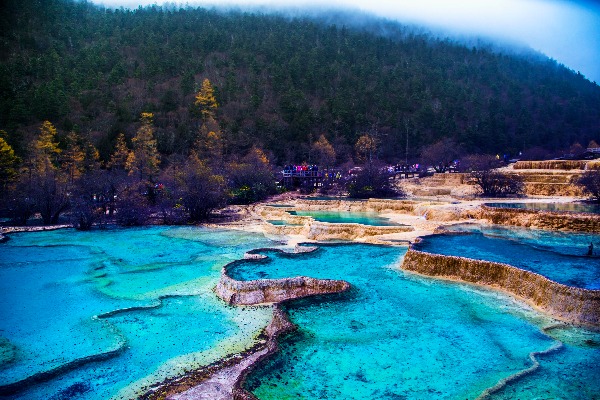
The core area of Huanglong Scenic Area is dotted with more than 3,000 colored ponds. With the surface tufa landscape with ingenious structure and colorful colors as the main scenery, it consists of Huanglonggou, Danyun Gorge, Munigou, Xuebao Ding, Red Army Long March Monument Park, etc. The main landscape is concentrated in the Huanglong Gully, which is about 3.6 kilometers long. The ditch is full of calcium carbonate tufa deposits and is rich in animal and plant resources.

Jiuzhaigou is a World Natural Heritage site, a national key scenic area, a national AAAAA-level tourist scenic area, a national nature reserve, a national geological park and a member of the World Biosphere Reserve Network. It is also the first nature reserve in China with the main purpose of protecting natural landscapes.

Wuhua Lake, located in the Jiuzhaigou Scenic Area, is one of the most beautiful lakes in Jiuzhaigou.

Panda Sea is located in Jiuzhaigou, Sichuan, with an altitude of 2587 meters, a depth of 14 meters, and an area of 90,000 square meters. Panda activities often occur here, hence the name Panda Sea. The texture of the rock wall by the lake is unique, reflecting the lake, and contrasts with the round white stone like a panda with several circles of black patterns naturally growing underwater beside the lake. It is one of the four major waterfalls in Jiuzhaigou and the one with the largest drop among Jiuzhaigou waterfalls.

There is a scenic spot in Jiuzhaigou that is the most amazing, where the colors of water vary from deep to light, blue to green, as if it has assembled all the colors that water can have. Along with the rocks, aquatic plants, moss and branches, it nearly encapsulates all the highlights of Jiuzhaigou into one.

Changhai has an altitude of 3060 meters, a length of about five kilometers, a width of about 600 meters, and an area of 930,000 square meters. The mountain peak next to Changhai is covered with snow all year round, and the forest is surrounded by green pearls. Standing on the Changhai Observation Platform, you can have a panoramic view of the blue sky, white clouds, and the snowy peaks. It feels that the mountains and the sky are connected to each other without distance. This is also a big sight of Changhai. Poetry and Fu: The sun reflects the snowy mountains and the blue clouds, and the ancient trees bloom with the blue waves.

Shuzheng Qunhai Scenic Area is the gate to the beautiful scenery of Jiuzhaigou. The Shuzheng Group Trench has a total length of 13.8 kilometers and has more than 40 lakes (haizi) of various types, accounting for about 40% of all lakes in Jiuzhaigou Scenic Area. The water from the upper sea climbs over the lake embankment and overflows from the trees, stirring up white water droplets, jumping and shuttling in the green. The water flows up and down along the embankment, forming a curtain of water, graceful and changing. The entire group of seas is clearly stratified, with blue colors in the green, and fairytale innocence and nature.

Bao'en Temple was built by a local chieftain in the Ming Dynasty. He spent a large amount of money to hire 20 craftsmen who had participated in the construction of the Forbidden City to build it. It was constructed completely by referring to the architecture of the imperial palace. Therefore, Bao'en Temple is also known as the "Forbidden City in the Remote Mountains".